
Oleh Ladan, SkladUSA: “We Help Ukrainian Businesses Sell Worldwide”

Oleh Ladan, founder of SkladUSA, was a guest on the YouTube channel Young Business. In a conversation with Slavik Nedbailo, he spoke about international logistics for small businesses, shipping goods from Ukraine to the United States and Europe, fulfillment, Amazon, Etsy, oversized shipments, customs duties, and tariffs.
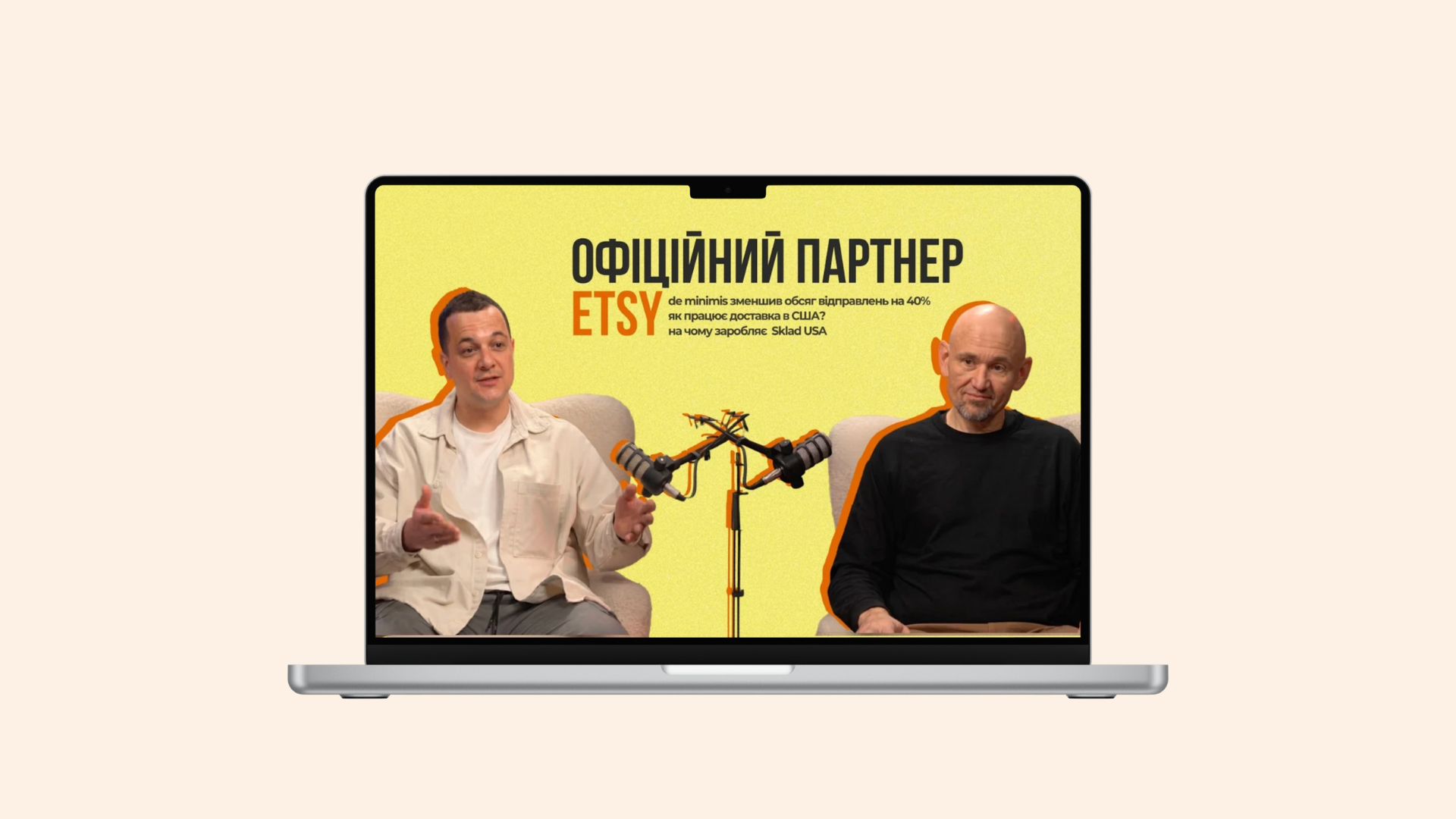
This is a polished written version of the interview, preserving the key ideas, the structure of the conversation, and the practical explanations that may be useful for Ukrainian entrepreneurs who already sell internationally or are just planning to enter global markets.
The conversation also covered Oleh’s personal journey: moving to the United States, his first experience in logistics, volunteering since 2014, returning to Ukraine after the start of the full-scale invasion, and his decision to support the country not only through business.
Who Is Oleh Ladan and What Does SkladUSA Do?
Slavik Nedbailo: Oleh, if you had to briefly explain what SkladUSA does, what would you say? How do you explain it, for example, to your children or your mother?
Oleh Ladan: To be honest, my kids don’t really understand what I do. If I explain it simply, SkladUSA is a warehousing and logistics company. More precisely, we are a 3PL company.
3PL stands for Third Party Logistics. In other words, we are not FedEx, DHL, or a direct carrier that physically delivers every parcel from point A to point B. We work as a logistics partner between businesses and major international carriers.
We have access to terms, rates, discounts, shipping volumes, and personal account managers. We use these opportunities so our clients can ship goods more conveniently, more cost-effectively, and with better support.
When a small business approaches a major carrier directly, it is simply one customer among many. Even if that business ships 500 parcels a month, it still does not have the volume that a company like ours has. That gives us different opportunities when it comes to negotiations and resolving issues.
We also provide services that a direct carrier usually does not offer. For example, consolidation, fulfillment, warehouse processing, shipment preparation, handling larger batches, engraving, and other additional services.
How SkladUSA Started
Slavik: Did you start as a warehouse in the United States?
Oleh: Yes. In 2018, we opened our first warehouse in the United States, in Minnesota. The idea was to give Ukrainian sellers the ability to store their products closer to their customers.
At that time, many people were selling on eBay. If the product is already stored in a U.S. warehouse, it does not need to be shipped from Ukraine every single time. An order comes in, the warehouse packs the item and ships it to the American buyer. That is fulfillment.
With Etsy, the situation was a little different because Etsy is more closely connected to personalization. Products are often made or customized for a specific order. But over time, we began working with that segment as well.
When Ukraine began facing power supply issues, especially in the fall of 2022, we launched engraving services in the United States. Many of our clients were doing personalization at a large scale, and they needed to continue working regardless of power outages.
Nova Poshta, Ukrposhta, DHL, FedEx: Competitors or Partners?
Slavik: How do you operate in a market where there are companies like Nova Poshta, Ukrposhta, DHL, and FedEx? Do you compete with them, or do they complement what you do?
Oleh: Both. They can be competitors, partners, and part of the logistics chain at the same time.
For example, Nova Poshta may be cost-effective for certain shipments under 2 kilograms. But when we are talking about larger volumes, consolidation almost always wins.
In terms of delivery time, consolidated shipping is often roughly the same, and sometimes it can even be faster. At the same time, direct carriers usually offer direct shipping only. They do not consolidate shipments for a client the way we do.
There is another point. Large carriers are not always flexible. They may fail to deliver on time, deliver to the wrong address, fail to bring the package to an apartment, or hand it over to a partner. Then the client has to figure it out on their own.
And as a small client, you are not always that important to the partner.
Our advantage is that we work in a more human way. We know exactly what is being shipped, who needs it, and how it affects the client’s business. If a problem arises, we do not say, “That is no longer our responsibility.” We look for a solution.
What Is Consolidation and Why Is It Cost-Effective?
Slavik: Explain in simple terms what consolidation means.
Oleh: Imagine that you have several orders. Your friend has orders too. And ten more entrepreneurs who work with us also have their own parcels.
Each of them sends their goods to our warehouse in Kyiv. Someone sends one box, someone sends ten orders in one box. We receive everything, sort it, pack it together into a larger shipment, and send it as consolidated cargo.
That is where the economy of scale comes in. If every parcel is shipped separately by express delivery, it will be more expensive. When many parcels travel together, the cost for each client becomes lower.
For example, express delivery of a small parcel may cost around $28. If it is sent through consolidation, which usually arrives in about 10 calendar days, the cost may be almost twice as low.
Yes, the delivery time may be a few days longer. But for many businesses, that is a reasonable trade-off.
Oversized Shipments and Delivery to Amazon
Slavik: SkladUSA has a strong oversized shipping service. How does it work?
Oleh: We have freight directly from FedEx. They know that we regularly deliver large shipments, pallets, large boxes, and non-standard dimensions.
Items that regular FedEx Express cannot always handle, or cannot handle cost-effectively, can be shipped through freight solutions. There is FedEx Freight Express and Freight Economy.
We transport these shipments together with consolidations and express parcels to Katowice, and from there the cargo goes by air. Most often, it goes to the United States because about 85% of our clients’ sales are in the U.S.
The cargo can go either to our warehouse or directly to Amazon warehouses.
For example, a client may have 20 boxes of backpacks. If each box is shipped separately, it can be expensive. Let’s say $70 per box. If those boxes are placed on a pallet, the shipment may become significantly cheaper.
Yes, it may take 3–4 days longer. But for wholesale orders, that is normal. Buyers understand that the goods are coming from Ukraine.
Why the Price of a Large Shipment Can Change Every Day
Slavik: So with pallets, the price is not always fixed?
Oleh: Correct. There are many nuances in freight shipping. Prices can change depending on how full the aircraft is.
For example, if a FedEx aircraft is full on Monday but has more available space on Tuesday, the cost may be lower.
A client writes, “I have two pallets today, and I need them delivered.” We check the price and may say, “Let’s try tomorrow. It looks like tomorrow may be better.” The client waits one day and may save $400.
Sometimes discounts can reach 30% or even more, especially outside the peak season.
It is similar to airline tickets. The price depends on capacity, the day, and demand. That is why oversized shipments cannot be fully automated through an API. You need to go into the carrier portals, check dimensions, dates, options, and calculate everything manually.
But for the client, this is often more cost-effective.
How Oleh Ladan Got Into Logistics
Slavik: SkladUSA was founded in 2018. But you had a long journey before that. How did you get into logistics?
Oleh: I moved to the United States in 1990. I finished school and started studying to become a doctor. At the time, medical and emergency room TV shows were popular, and I really liked that.
But at 19, I realized I did not want to do it anymore. In the United States, the path to becoming a doctor is very long: college, medical school, then years of specialization. It can take 15–20 years of training before you become anyone in the profession.
I decided I wanted to try something else.
I moved from Rochester to Minneapolis and enrolled at the University of Minnesota to study international relations. I kept returning to Kyiv all the time. For me, a vacation always meant going to Ukraine. I would fly there once or twice a year and think: maybe if I study international relations, one day I will be able to work at an embassy in Ukraine.
After graduation, I started working for an e-commerce company. Later, a friend invited me to work as a logistics specialist in Guyana, in South America. That was in 2009. I was interested in taking on the challenge.
I worked as a director of logistics. We supplied everything: from food for people working in the jungle to drilling equipment.
It was not an easy experience. The jungle sounds romantic, but in reality, it comes with many problems: malaria, dengue fever, high fever, hospitals, IV drips. I had both malaria and dengue.
But that was where I really became interested in logistics. Because it is a job where there is no single simple solution. You are constantly looking for routes and options. You have to understand carriers, customs, documents, and transportation routes.
I found that interesting.
How the Idea for SkladUSA Was Born
Slavik: When did the idea for your own company appear?
Oleh: A few years before SkladUSA, Mykola, my co-founder, and I began selling products from Ukraine on Etsy.
Sales were going fairly well. But we saw a problem with delivery times.
At that time, there was essentially only Ukrposhta. Parcels could take weeks, sometimes a month and a half, to arrive. For e-commerce, that is very difficult. We realized we could not sustain that model.
We registered the company in 2017, but we actually started operating in August or September 2018. That was when we rented our first warehouse in Minnesota, began bringing products there, and started explaining to Ukrainian sellers that fulfillment was the future.
The name SkladUSA reflected the idea very directly: a warehouse in the United States for Ukrainian businesses.
How the Company Developed After Launch
Slavik: What services did you add first?
Oleh: After fulfillment, we began accepting payments because clients themselves asked for it. They would say, “We already work with you for fulfillment. It would be convenient if we could pay for your services from the same funds.”
Then DHL came to a meeting with us in Ukraine. They offered good rates at the time. But for express delivery, it was still expensive.
So we thought: why not try consolidation?
In November 2018, we shipped our first consolidated shipments. We did not even have the full functionality for it in our system at the time. But there was demand, and we started moving in that direction.
Later, during COVID, growth accelerated sharply. Everyone moved into e-commerce, Etsy grew significantly, people stayed home, bought online, and sellers were earning. That was when we moved to a larger warehouse.
Etsy and Shopify: Different Paths for International Sales
Slavik: For many Ukrainian sellers, Etsy remains the first step into international markets. But there is also Shopify. How do you see the difference?
Oleh: Etsy is an easier starting point, both in terms of investment and documents. It already has an audience, traffic, and people who are looking for products.
Shopify is a different story. It is your own website, your own brand, your own audience. It is an asset that you build yourself. But it requires more investment: in traffic, advertising, the website, sales systems, and payment solutions.
For Shopify, it is important to have proper payment system integration. Buyers want to pay quickly: by card, Apple Pay, Google Pay. If there are issues with payments, it affects conversion.
So businesses need to think not only about the website. Etsy is easier for getting started. Shopify is more of a long-term game.
Warehouses in Ukraine, the United States, and Poland
Slavik: How is SkladUSA’s warehouse operation organized today?
Oleh: We have Kyiv, Minnesota, and Poland. In Ukraine, we also work with different cities: Odesa, Zaporizhzhia, and Lviv.
After the start of the full-scale invasion, we moved the guys who worked at the warehouses to Lviv. That was necessary for safety and to keep operations running.
We have shipping schedules. For example, shipments from Tuesday and Wednesday are grouped and sent on Wednesday. This allows us to plan processes.
In Minnesota, my sister manages the warehouse. She is the general manager. She is responsible enough to keep that process running.
Warehouses in other countries are not always simple. For example, in the United Kingdom, VAT is required, and for now we decided that we do not need it at this stage. You need to look not only at the desire to be present in many countries, but also at the economics, taxes, documents, and operating costs.
There is also a difference in expectations. In Ukraine, everyone is used to parcels arriving very quickly. In Europe, people are calmer about that. A two-week delivery time can be normal there.
People, Automation, and the Warehouse After the Attack
Slavik: How difficult is it now with people and operations?
Oleh: Very difficult. The number of people who can work is decreasing. Men are joining the army. Some people have left the country. Manufacturers in Ukraine are also struggling to find workers.
We were trying to move more actively toward automation, but last year our warehouse was damaged. The back part of the warehouse was destroyed. We were lucky that some of the equipment remained. But of course, it affected the processes.
Automation is very important for us now. We want to introduce tools that will help reduce manual steps, minimize mistakes, and process shipments faster.
The SkladUSA Team
Slavik: Who do you look for when hiring?
Oleh: We do not look only at formal experience. For warehouse work, responsibility, attention to detail, and readiness to work with processes are important.
In Minnesota, we have around 15 people. Part of the team is Ukrainian. There are also non-Ukrainians, including people from Moldova. Many women came under the U4U program.
We see that Ukrainians usually work very well in these processes. They learn quickly, they are responsible, and they understand what a client’s business means and why a mistake in a parcel can cost someone a sale or their reputation.
Customs Duties, Tariffs, and Changes in Shipping
Slavik: What has changed because of duties, tariffs, and the de minimis situation?
Oleh: Shipping volumes in 2024 dropped by approximately 35–40%. That affected both consolidated shipments and express shipments.
The reason is clear: if a consolidated shipment takes three months to arrive, a business cannot operate normally.
Later, carriers reached agreements, and the processes stabilized. After we switched to shipments through brokers, delivery times improved, and people started coming back. They saw that shipping was working again.
At the same time, express shipments did not grow back to where they were before the de minimis changes. Consolidations are doing the best right now because we are focused specifically on shipping and warehouse services.
We are not trying to do everything at once. This is our core business.
I remember 2022, when everything stopped. But already in March, we started shipping again. For us, it is important to look for solutions even when it seems that logistics has stopped.
At the same time, significantly increasing volumes is difficult now. Not only because of logistics. There are issues with labor, energy, and migration. Many manufacturers cannot scale because there are not enough people to produce goods.
Official Partnership With Etsy
Slavik: You became an official Etsy partner. How did that happen?
Oleh: Etsy representatives reached out to us themselves. They saw that many Ukrainian sellers were using us as their shipping partner. They saw tracking numbers and saw that shipments were going from Minnesota.
For Etsy, it is important that parcels arrive quickly and that sellers have stable logistics. If sellers work with us, they get a better experience.
The negotiations lasted around three months. They had their requirements, and we had ours. We said directly that we would not agree to terms that did not work for us.
They also wanted us to become official partners in Poland and the Czech Republic. We said that at this stage, we would agree to Ukraine.
Official status gives us integration and direct communication with Etsy management. If we need something, we can contact them directly.
But it is important not to go along with everything simply because it is a large company. You need to calculate the economics, terms, and integrations. None of this is free, and it does not cost just a few hundred dollars. These processes can take a month or a month and a half.
Personal Story: Moving to the United States and Oleh’s Brother
Slavik: You moved to the United States because of your brother’s treatment. Tell us about that.
Oleh: My brother had a tumor on his pituitary gland. Because of that, he grew very quickly. He became a record holder, was included in the Guinness World Records, appeared in films, and performed at Eurovision with Lata.
When he was four and I was eight, he was already very tall. He was treated in different hospitals, but no one gave clear forecasts.
In Minnesota, there is Mayo Clinic, one of the most famous medical centers in the world. Presidents, athletes, and sheikhs go there. My mother and brother came there in 1989, and a year later I moved as well.
The doctors said the treatment would be lifelong, so we had to stay.
I was 14. The move was not too difficult because at that age you adapt quickly. But responsibility came very early.
We did not arrive with money. My mother worked, cleaned houses, washed dishes. About six months after moving, I also started working: I washed dishes at a Greek restaurant, and later had other jobs.
That taught me responsibility.
Volunteering Since 2014
Slavik: When did you start helping Ukraine?
Oleh: Since 2014, we have worked with Yana Zinkevych and the medical battalion of the Right Sector. We supplied tourniquets, hemostatic agents, and other necessary items.
When the active phase of the Anti-Terrorist Operation calmed down a little, we started working with Tabletochki, Voices of Children, military foundations, including Serhiy Prytula’s Foundation, Come Back Alive, and also units that carry out special operations.
There was a case when, a month before the full-scale invasion, we brought in special equipment for snipers. Ukrainian customs detained it. I was fined and, in effect, taken to court.
We went all the way to the court of appeal and won the case. After the hearing, they took us to the warehouse and returned all the equipment.
After that, with my American passport, I brought vehicles from Poland. Today, we help a lot, including the Khartiia Brigade, but not only them. There are units I cannot speak about publicly.
February 24 and the Decision to Return to Ukraine
Slavik: Where were you at the beginning of the full-scale invasion?
Oleh: I was on a plane from February 23 to February 24. There was news on the plane, and I saw Putin’s speech.
One of our clients, Yurii, met me in Warsaw and drove me to the border. On February 27, I crossed the border on foot.
Slavik: Why did you decide to return?
Oleh: How can I talk about Ukraine and do nothing? It does not work that way for me. If I say this matters, I have to act.
They could not take me into the army because of my citizenship, but for the voluntary territorial defense formation, that was not an issue in the same way. I joined a voluntary formation of the territorial community. We were there for about a month or a month and a half, until Kyiv region was liberated.
For me, it is very important to thank those who defend Ukraine. Without them, there would be no business, no conversations, and no future.
How Oleh Ladan Recovers
Slavik: How do you deal with stress?
Oleh: The sea. If I can, I go with my children. There were periods when I went alone because I needed to recover somehow.
I also work with psychologists. I believe this is a very important part of life. It helps me in my relationship with my children as well. I do not bring stress from work or the war home.
I love to travel. Right now, there is not much time: it is either work or trips to Ukraine. But even when I come here, I allow myself to go to Zakarpattia, to the Carpathians, to drink mineral water.
The gym also helps me. Lifting weights, switching focus. I am happy that I have this business and these clients. That also gives me a sense of grounding.
Children, the Ukrainian Language, and the Memory of War
Slavik: Are your children connected to Ukraine?
Oleh: When they come here, they start learning to speak Ukrainian at home again.
I took them to towns in Kyiv region where fighting took place, so they would understand what a “good neighbor” means and that the world is not simple.
For me, it is important that they see Ukraine not only as a place for vacation, but as a country that is fighting and paying a very high price.
How People in the United States See Ukraine
Slavik: How do people in the United States view Ukraine now?
Oleh: My circle of American acquaintances is not very large. Mostly, it is our people or people we work with. They, of course, support Ukraine.
At FedEx, for example, we have a manager who constantly asks how things are going, how Ukraine is doing, and wishes that we can return to normal. People know what is happening.
Of course, politics has an impact. There were concerns because of Trump’s statements about weapons or aid to Ukraine. At the same time, many people in the United States understand who is good and who is bad in this situation. Even among MAGA supporters, there is a percentage of people who support Ukraine.
What Oleh Ladan Reads and Watches
Slavik: What do you read or watch?
Oleh: I do not watch a lot of business content. Sometimes I watch Slavik’s channel. Sometimes I read something while on vacation.
I liked the book about essentialism. I can see that I am moving in that direction myself. Even before I started reading it, I already felt the need to remove what is unnecessary and focus on what matters. The book simply pushes you to make changes in yourself.
And sometimes I just want to put something on in the background to switch my brain off. Sometimes I find some light shows on YouTube. That is necessary too.
Advice to His 20-Year-Old Self
Slavik: What would you advise your 20-year-old self?
Oleh: Youth should be youth. Meetings, bars, concerts, fun — that is normal. But at some point, it should come to an end. Roughly speaking, by the age of 26, you need to start directing yourself in the right direction.
And you need to take risks. If you only follow one clear road and do not look anywhere else, that is a mistake.
At SkladUSA, we made many mistakes. But eventually, you still come to a point where you understand that the risks were worth it. Even if in the moment it seems like everything is going badly.
You need to live here and now, understand what you are doing, take risks, and move forward. Do not waste time on things you will regret later.
Simply living a life is not that interesting. You need to achieve something for yourself. You do not have to be the CEO of a large company. But you need to set goals and move toward what is truly interesting to you.
Do not work somewhere you do not enjoy. Taking risks means stepping out of what is comfortable.
What Oleh Ladan Dreams About
Slavik: What do you dream about?
Oleh: The end of the war. The return of Crimea. Ukraine’s victory and a flourishing Ukraine.
Everything else I can do myself. But this is something I cannot influence as much as I would like to. I do not even have Ukrainian citizenship, so I cannot vote. And the right to vote is very important.
These articles may also
be helpful to you


Thanks for sharing your opinion. Please help us improve this material.
Your opinion is very important to us.